Wednesday, October 14, 2020

Back to Detroit, Back to Myself

Six years have passed since I last posted in Pakistan.  Or to be precise since I last posted then removed the posts.  I remember having terrifying thoughts that my posts would be found by one of the rogue terrorist groups that I read about in the newspapers every morning over breakfast.  I imagined that they would come find me in my guesthouse and find some creative way to do what terrorists do-cause terror.  In hindsight it seems laughable but the reality of terror is unpredictable.  

I recall leaving the country with both relief and a deep yearning to return as quickly as possible. Something captured my heart about the people of Pakistan-I felt the safest I had ever felt while being in a notoriously dangerous country.  Poetically, six years has passed but not much has changed.  I live in Detroit (the city, not the suburbs!), a notoriously dangerous city, and am surrounded by a community of very safe people in my apartment building.

In between Pakistan and Detroit, I lived life.  

It seems fitting to end this journey back where I started, but somewhere completely new.  And that somewhere is me.  


Home Setup Checklist

Checklist for Setting up Home

Kitchen

Large Dish soap

Large dishwasher detergent

Cleaning gloves

Sink disposal cleaners

Several sponges

Long-wand dish scrubber

Multi-pack paper towels

Multi-pack sponges

Mop

Broom and dust pan

Dusters

Kitchen garbage bags

Saran wrap

Alum foil

Parchment paper

Small plastic bags

Large plastic bags

Bottled water

Several kitchen towels

Fridge clip magnets

Chalkboard (?)


Kitchen equipment checklist

Whisk

Cutting boards

Wine glasses

Measuring spoons

Measuring cups

Liquid measuring cup

Several sharp knives

Tongs

Baster

Grater

Regular can opener

Wooden spoons


General kitchen supplies

Mustard

Mayo

Eggs

Olives

Capers

Minced garlic

Hot sauce

Siriacha

Ketchup

Salad dressing

Spice packs

Baking soda

Coffee

Coffee filters

Paper dinner napkins

tupperware


Bathroom(s)

Large toilet paper

Plunger

Bowl cleaner wand

Bowl cleaner detergent

Shower scrub brush

Shower scrub liquid or detergent

Windex cleaner tissues

Multipurpose tissue cleaners

Small bathroom garbage bags

Box(es) of Kleenex tissue


Bedroom(s)

Glass water bottle

Coasters


Office Area

Cork board/dry erase board

Calendar desk pad

Small calendar for fridge


Living Room

Candles

Air freshener (from bath & body works)


Laundry

Large Laundry detergent

Large fabric softener

Dryer sheets

Delicate wash cleaner

Drying rack

Bleach


The Almost Marriage

The Almost Marriage


“Broken engagement”.  I hated that term.  “There is nothing ‘broken’ about me,” I would scowl to myself as I reflected upon the realization that, in fact, after ending my engagement I felt more whole.  


The engagement had been tumultuous to say the least.  Mostly, I felt confused.  Isn’t this what I wanted?  Hadn’t I already committed myself to the relationship by moving cross-country for him?  I recall throwing my engagement ring across the room screaming that I didn’t want to be someone’s wife, as if by being married I would forever be playing second fiddle. Gone were the cozy feelings of a home that I desperately tried to create.  


Ending my engagement felt like a strange “in between a relationship breakup and a divorce.  There was no legal paperwork, no lawyers, no alimony.  But there was an entangled life together and a half-planned wedding. 


The “not wedding”?  Ex-fiance sounded harsh.  The almost husband. The almost mother-, father-, brother-, and sister-in-law.  The almost life.  My almost divorce.  

Personal Security

Personal security is obviously an issue in Pakistan.  I've been challenging myself to not let these issues define and color my experience too much while I'm in Pakistan because the reality is a constant undercurrent.  These concerns are not just evident for visitors.  Pakistanis will shake their heads and ask if I think things will get better.  One can only hope.

I've been keeping a low profile.  Most of the time I do not cover my head (not all Pakistanti women do) but always a scarf with me.  However, I do cover my head during car rides.

Low profile 
It feels very different and sometimes unsettling to be in a place where my mobility is so limited.  I'm used to exploring new places by foot, wandering the side streets and adventuring to tucked away cafes.  I haven't walked down any street.  Not one.  Door-to-door service for every place you go seems somewhat of a celebrity life.  As does constantly arranging your driver to pick you up here at this time and take you there.  Until you realize that you're somewhat under house arrest at each place you go.

View of my street from the car

The concept of having a private driver is certainly not unique to Pakistan as this would also be a preferable  and affordable arrangement in other more peaceful middle-income countries.  However, feeling wary of a 10-minute walk to the market by myself during daylight hours is palpably different.

Driver.
The extra psychological effort required to keep any security concern in realistic check is evident. I've been advised not to go to the brand-new shiny shopping mall with stores, a cinema, and a TGIFridays.  A landmark screaming of of the West.  Each car that pulls up to the McDonalds must pass through a security check-point.  All major roads have occasional policed checkpoints where passing cars slow down to swerve through the concrete roadblocks.

We never go out to a restaurant for lunch at the office, always ordering take-out to eat at the office.    The lovely patio garden, balcony with a view, and chirping birds of my guesthouse seem to peacefully co-exisit with the barbed wire wall around the building and two beret-wearing rifle-slinging security guards guarding the thick metal gate of the driveway.    


Security guards and gated entryway
When I was discussing weekend plans with my colleague, I suggested the major city sites that I wanted to see.  But wait.  A popular city landmark.  On Saturday afternoon.  Fuggedaboutit.  These places will be crowded on the weekends, he reminded me, and suggested we go during the week instead.  So we made a plan to visit all the popular places during the weekdays after work when they are less crowded and by proxy, safer.

Reality bites.  But comfort always awaits at the end of each day.  I retreat to my room, nestle under the blankets, cuddle up with my iPhone and fall asleep.

Plaque outside my room.  Not all the rooms have it.  Not sure why but I'm grateful.

Thursday, March 13, 2014

Shopping

After work last Friday, I went shopping with the girls, which was much needed girl time and retail therapy after my first week adjustment to Pakistan living. My colleague was looking for fabric for a tunic to wear to our other colleague's wedding reception.  She wanted fabric that would match a purple shawl, a family heirloom that her mother had embroidered by hand.  


Choosing from many colorful fabric choices

After the fabric store, we went to one of their favorite clothing stores, Khaadi, where I bought a royal blue tunic topic and nearly a dozen scarves.  The word, khadi, is the term for hand-woven cloth mostly spun from cotton.  

The shalwar kameez is the traditional women's dress style consisting of baggy pajama-like trousers with a long tunic.  This is accessorized with a dupatta, a long scarf that is worn over the shoulder or draped over the shoulders like a cape.  I've noticed that professional women in Pakistan generally don't cover their heads but most have some type of shawl accessory.  Most professional women dress like this Khaadi model.

Khaadi model in a shalwar kameez with a dupatta.

In casual settings, women often wear leggings and sometimes jeans as bottoms with a tunic-style top.  My colleague explained that fashion trends for shorter above-the-knee tunics and longer ankle-length tunics rotate.  Now, she explained, the shorter tunics are the trendy item.

Traditional dress for men is a kurta, a long tunic shirt.  The taqiyah is the cap that some men wear like the man in the picture below.  Muslim men wear this cap to emulate the Prophet Muhammad (pbuh) who wore one.  But in professional settings, men are more likely to wear western-style clothing. 

Khaadi male model in a kurta and taqiyah.


Successful shopping outing.

Paisley print Khaadi shopping bags

Monday, March 10, 2014

First Impressions


My flight to Pakistan involving an overnight layover in Abu Dhabi, the capitol and one of the seven emirates of the United Arab Emirates.  The layover was very brief only allowing time to check into the hotel next to the airport and get at least some sleep before my early flight to Islamabad.  Small details hinted at the area's opulence in a Muslim country.

I didn't see one non-luxury class car waiting outside the airport nor in the parking garage I walked through to get to my hotel.

White Lexuses outside Abu Dhabi Airport

In the airport, I picked up a "Time Out: Abu Dhabi" magazine, which ran a cover story of "Are you paying too much in rent?" From the story I learned that not only is rent pricey, it is common practice to pay rent annually.  This dismal situation is further burdened by the fact that landlords can legally increase the rent whenever they like.  A rental price cap was removed 4 months ago, and since then rent has increased by 16%.  This article also introduced me to Sharia Law, the Islamic religious legal code.  According to the article, in the UAE, Sharia Law does not allow unmarried couples to live together and is punishable by a prison sentence.  Sharia Law systems differ by country and are nuanced enough for a much longer discussion later.

First Images


News Anchors in Abu Dhabi (Note: the man in the lower left is signing in sign language)

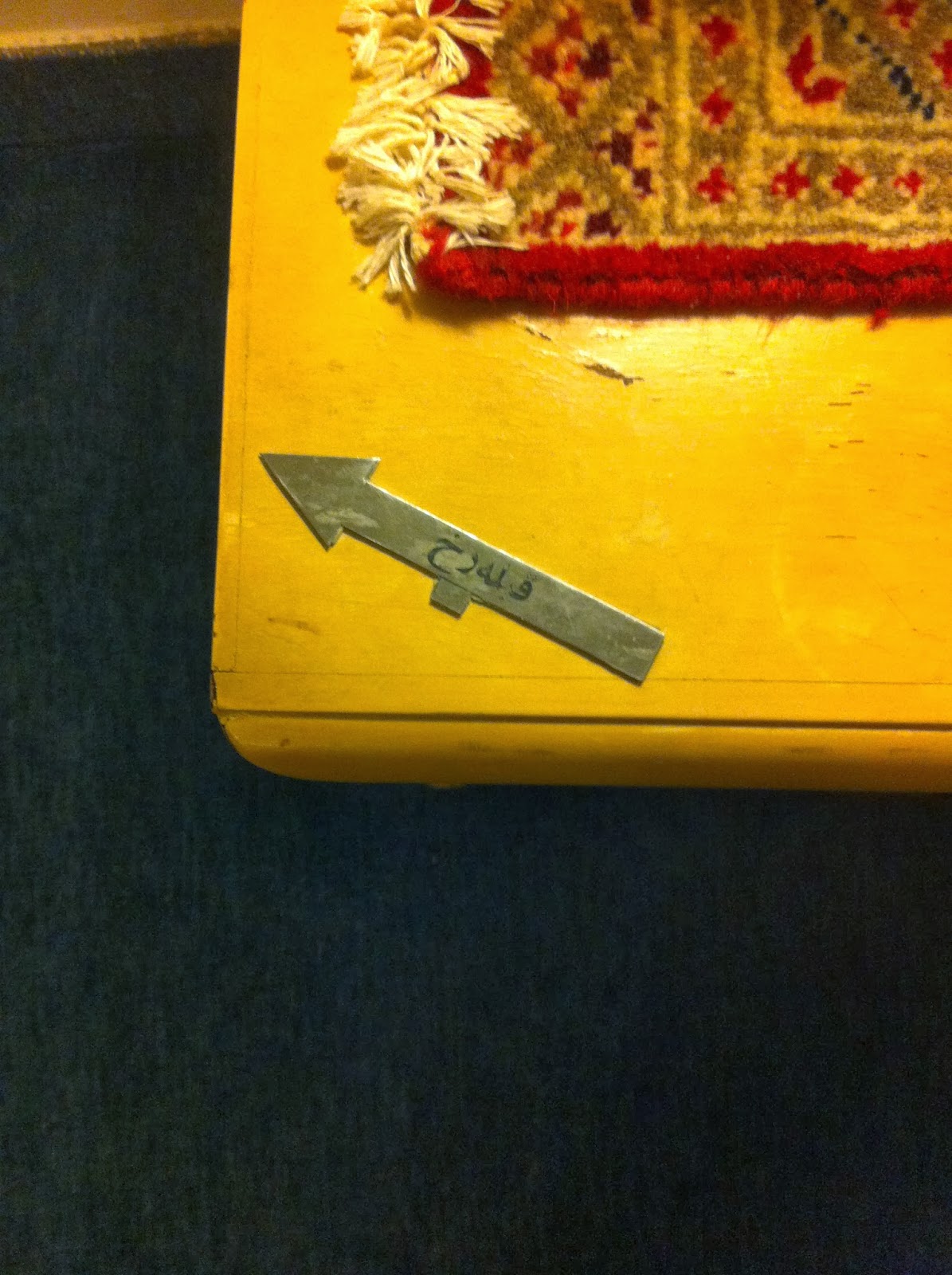
Qibla, or direction of prayer, glued to bedside table

Water nozzle in the bathroom for washing feet and head for daily prayer


Religion, health, and governance seem to be the key themes for this trip.  While I'm here my project is working on a strategy to engage ulama, Islamic religious leaders, in a program that aims to create more public demand for maternal and child health services and hold the government accountable for the provision of quality services.  No easy task, but more on this later.

Saturday, March 8, 2014

Back in the saddle, in Islamabad, Pakistan


It's hard to believe that a full two years has past since I last posted in this blog.  My last post was just a couple of weeks before I was accepted to graduate school.  Ever since then nearly all my extracurricular energies and even creative output like poetry have been devoted to this ambition. When your love poems are about statistical distributions, then you know you're ingrained in your science.

When I finalized my plans to go to Islamabad, Pakistan for a month for a health communication project as part of a global health grant I received as a graduate student, I figured I would dust off the 'ol "Discovering A Dream" blog.  I started this blog in the fall of 2008 when I set out to teach English for a year in Hanoi, Vietnam.  This is (almost) my longest time abroad since then (minus a 5-week South American backpacking adventure two summers ago).  Embarking on this new project in Pakistan made me reflect on my past significant international endeavors.


Reflecting back on my past trips made me laugh:

....at what an inexperienced and innocent traveler I was...


 First blog post in 2008 about first trip to Asia.  All my luggage was poorly packed.  Such an amateur.
"My first steps.  Walking through five airports in 24 hours.  Detroit. Chicago. Los Angeles. Taipei. Hanoi.  All the time praying that my overweight suitcase will make all my connecting flights while trudging through airport security lugging a briefcase, fleece coat, and my overstuffed backpack dangling a pair of tennis shoes, umbrella, bike helmet, water bottle, and a portable backpack.  Yes, I agree with the flight attendant, all I am missing is a tent."

...at how much communication technologies change....


Study abroad email circa 2007 citing AOL Instant Messanger as "essential contact information".
"Bonjour!  Thanks to everyone for all the good wishes of bon voyage! and support as I Frenchify my life.   Here is some essential contact information:
 Email: ebaughma@umich.edu  AIM Screenname: peachesb12"


...at embarrassing cultural mishaps....


 How many shades of red did I turn when someone explained what I had accidentally done?
"Today I unknowingly wrote the Vietnamese equivalent of "pussy" on the board.  My students roared with  laughter."


Reflecting also made me cry:

....when reading about some touching memories that I had forgotten...


 Teaching my Vietnamese friend how to swim on our trip to Da Nang.

"I had brought along an extra bathing suit for Van as she did not own one.  She had only been to the beach once before, two years ago.  This time we were at Lang Co Beach, which had been voted best beach 2009 in Vietnam.  It's no doubt as to why.  A stretch of beach alcove between mountains, white sand and gentle waves.  The shore still unspoiled by tourism.  
'Emily, can you teach me to swim? Emily, I want to swim in one day, is it true?'  Standing thigh deep in waves I racked my brain for a beginning point.  I showed her how to tread water with her arms to keep aloaft in the water and guided her through an elementary freestyle stroke.  Like a 7-year-old  learning to ride a bike without training wheels, I guided her through the salty water, then periodically let her go."  

Remembering my Vietnamese dan bau instrument lessons and how beautifully the blind student played.

"For my first lesson I arrive early and walk in the small practice room where a young Vietnamese boy delicately plucks the string.  He wears dark glasses.  After his lesson is over and he exits the room, I clarify with my teacher Mr. Binh.  Not knowing the Vietnamese word for blind person, I try, 'Anh ay la nguoi khong xem?'  He is a person who can't see?  'Yes', Mr. Binh says."

The moment when I was able to locate my distant Polish relatives in a small village outside Krakow.


"I sat at the kitchen table with the woman’s elderly mother, who had a striking resemblance to my own Polish grandmother.  After graciously accepting some tea, I sat in silence and witnessed the woman make phone calls in Polish wondering whom she was speaking with and what they were discussing.  Nearly an hour later, she looked at me with a huge grin.  She now had two phones in her hand, and was having two simultaneous conversations.  She was talking in Polish and handed me one of the receivers.  I heard a voice say in English, “Hello, I am Maria’s son.  My mother has told me that she has found your relatives.  Write down your phone number and she will have them contact you with the help of a translator.”  I was ecstatic."

Global Health

I think I remain the same dreamer as my blog title alludes to, although now my dreams are more sophisticated and focused.  And now, here I am, typing this from the lovely courtyard at my guesthouse in Islamabad, Pakistan.

View of Margala Hills, the scenic backdrop of Islamabad

Tuesday, February 7, 2012

Life's Moveable Feasts

During an TV episode of Anthony Bourdain's "No Reservations: Vancouver", Anthony dines with his chef chums and asks them what they would eat for their last meal on earth.

"Fugu," one man said, "...because I'm already dying anyway!"

Fugu

To appreciate the humor of this statement is to know that fugu is the japanese word for pufferfish, a fish that--if prepared incorrectly--is lethal.  Around the table everyone laughed, their faces flushed red from too many raised glass toasts.

Later, I concluded that, certainly, there is no better way to die than around a lively dinner table with friends.  My most cherished memories have been embedded in meals rich in conversations that make my eyes sparkle.  Last weekend's dinner party was no exception: I lifted my pink plastic flute of champagne to toast my oldest friend, Ashley, on her recent engagement.  "Your love is an inspiration to all of us," I started.  Distinct memories rushed forward of the first time I met Ashley and her twin, Jenny, in kindergarten.  It seemed surreal to think that we were the same people standing here as when we viewed the world from only a couple of feet above ground.  20 years ago felt both gargantuan and miniscule.  As if those years passed by like a meandering stream but we realized our life was a single drop in an ocean.

I'd like to make my drop count by building a life of moveable feasts.  Ernest Hemingway receives credit for the poetic phrasing of moveable feasts.  And it's no surprise that Paris, a city culture of institutionalized three-hour meals, inspired this graceful truism.

Paris by night

Speaking of moveable feasts, one of the recent trends in the foodie scene is pop-up dining, which created a buzz last summer and began in...Paris. (Are you surprised?)  The New York Times documented the action and other cities wanted to prove that they were also gastronomically sophisticated.  In response, the Atlanta Underground Market organized Feast Noir, a flash mob feast in which over a 1,000 Atlantans dined al fresco on exclusively homemade food at tables of eight.

The rules were fairly straightforward:

  • Wear black
  • All food must be homemade
  • No plastic plates, cultury, or cups
  • BYOTAC (Bring Your Own Table And Chairs)

The location was undisclosed until the morning of the feast.  Preparing dishes for a meal with strangers at an unknown location provided a new challenge to my host of dinner party skills.  The actual event was a delight, as I expected dining with fellow gourmets to be.  A sommelier told tall tales of the wine business and another couple described their organic farm produce they sell at local farmer's markets.  We shared a meal together but more importantly, we built a community.  As night fell, we packed up our things and left, trusting our feast to memory's safekeeping.  Hoping for another moveable feast.  


Feast Noir 2011
Photo Courtesy of Jessica Wolff

Wednesday, September 7, 2011

Monday, September 5, 2011

Free Poems on Demand at the Decatur Book Festival

A man with three daughters.  Good legs. Monsters.  Hiding.  Sambones the dog.  Red lemons.  Sandwiches.  Bacon.  Healing.  Peace.

1.  Are the above names of...

a) Next year's summer blockbuster titles
b) Poetry titles
c) Award-winning Thoroughbred horse names
d) None of the above

If you were to pass the Free Poems on Demand tent at the Decatur Book Festival you might be able to deduce the correct answer, b) Poetry titles.  On Saturday afternoon I joined a couple of other poets from Free Poems ATL to write free poems on demand for festival-goers.  Free Poems ATL is a literary performance group that launched at last year's Decatur Book Festival and writes free poems based on any topic requested.    

Some passerby were hesitant to request topics.  Four people requested a poem about love.  One elderly couple approached the table, wanting a poem about love.  Jimmy, the poet sitting next to me, responded to the women that three love poems had already been written and suggested that she choose another topic.  "Well, how about old people love!" she exclaimed, "We're recently married," she softly explained.  Another person named "poop" as a poem topic.  One young man requested a poem for himself, wanted another poem for his sister, and called his mother asking her to choose a poem topic.

On average each poem took me 12 minutes to write.  

Here is a poem I wrote about bacon:


                                                            Another poem about hiding:


And last, my favorite poem of the day about red lemons:


Monday, August 22, 2011

Table-to-Farm: A Compost Institution


One of the more recent (and I might add, increasing fascinating) tenants in my apartment-block brain, is composting.  As I learn more about composting or the transformative process of food scraps to nutrient-rich soil, I can imagine this waste reduction process taking on an environmental "coolness" factor akin to bringing canvas bags to the grocery store to eliminate the paper or plastic bags you consume each shopping trip.  Food waste is the second largest waste stream in the United States after paper, according to the Environmental Protection Agency.  (Pretty interesting considering we are suffering from a national obesity epidemic.)  Considering this disturbing fact, why is composting not more institutionalized as a common form of recycling?  We have bins for plastic, paper, and glass--but where is the bin for my banana peel and stale bread?  Farm-to-table dining is the foodie's buzz word of the year.  But what about table-to-farm?  How about a full-cycle food industry?  A girl can dream.  For now I'll add "American Wasteland: How America Throws Nearly Half of Its Food (and What We Can Do About It)  to my reading list.

Monday, August 1, 2011

Cycle Culture


The instructions to my 2009 red Yamaha scooter documents each nut and bolt to my machine.  Literally.  The owner's manual details how to take off the side panels for a peek at the engine, outlines the air induction system, and catalogs where to get spare parts and new varnish for body touch-ups.  The maintenance schedule gives me the knowledge to offer informed guidance to my mechanics on what needs to be done at each mileage check-up.  But where are the rules about cultural cycle norms?

Beyond legalities, there are unspoken cultural nuances to scooter driving in Atlanta.  One of my favorites is the motorcycle wave.  It's akin to a secret handshake of an underground fraternity.  A quick dropped arm at a downward sloping 45 degree angle before returning to the safety of the handlebar grip.  This wave is a call to solidarity among scooter riders.  When I drive around town and pass another scooter driver we will use the wave as a friendly hello or simple recognition for the choice to be on two wheels.  Motorcyclists sometimes wave.  Their choice to wave, perhaps, depends on pride.  I find some motorcyclists to regard a scooter the way a child on a two-wheel bicycle would pitifully watch a toddler on a tricycle.  I let them silently guff.  They can't ride their machines in stiletto heels.

Monday, July 25, 2011

Don't have a good solution? Ask a better question.


"The mere formulation of a problem is often far more essential than its solution, which may be merely a matter of mathematical or experimental skill.  To raise new questions, new possibilities, to regard old problems from a new angle requires creative imagination and marks real advances in science" 
     -Albert Einstein 

Have you ever found a solution to a problem you faced?  How did you discover the solution?  Was there a series of questions involved?  How did you know what to ask?  Did you ever question yourself, or others?  Do questions beget questions?  Could a question create noise?  Could a question create silence?  Should a question have inalienable rights?  Would a question have regrets for being a question?  Are questions ever envious of declarative statements?  What does a good question taste like?  For that matter, what does a bad question taste like?  Is there ever a bad question?  What makes a good question?  What makes a great question?  What makes an outstanding question?  Have you ever questioned your questioning? What if you thought in questions all day long?  

Friday, July 15, 2011

Wanderlove

To travel is to live said H. C. Anderson.  His eternal words caught my eye and captured my heart in the Nobel Museum in Stockholm, Sweden.  After spending four engrossing hours in the small three room museum these words described my then current thoughts exactly.   I feel confident that H. C. Anderson and I would have been friends on facebook and I certainty would have followed his blog and perhaps his tweets as well.

I've alway appreciated quotations, particularly concise quips that read like a poetic mantra by which to live.  The 42 country stamps in my passport attest to the comings and goings of a self-proclaimed global citizen. But a victim of wanderlust?  Hardly.  This oft-diagnosed condition may cast an inaccurate reflection of the intentions of a well-seasoned traveller.  I'm not dealing with high school crushes anymore--I'm in wanderlove.  Love makes the world go round and so does an overnight bus to Oslo, Norway.  Perhaps, travel is like summer camp for adults: an opportunity to make new friends, learn new skills, and be in love with languid humid days.  This isn't my first trip and won't be my last as a traveling bon vivant.

Sunday, May 29, 2011

What Happens When It Rains?

When I tell people that my red Yamaha scooter is my main (and only) method of transport around the city they ask any number of questions.  Precipitation is sometimes a question they pose.

"What happens when it rains?" Their faces begin to twist in concern.

"Well..." I pause as I search for the missing correct answer that will appease their worried expressions. "...I get wet."

Staying dry while riding is something I appreciate and I do take caution to protect myself from the elements (i.e. acid rain).  I own a raincoat.  But there are times when even waterproof polyester won't cut it.  Thursday of last week was one of those times.

Just as I turned onto the busiest street in Atlanta on my way home from work, it concurrently erupted from above and in front of me.  Sheets of rain soaked me almost immediately and wind blasts threatened my balance.  In order to avoid any accident I was forced to pull over.  I stopped under an overhang and parked my bike in front of a dry cleaner's shop.  The Chinese restaurant next store called out to me, a reprieve from overburdened clouds.  Inside, I sat and ate my hot and sour soup despite the puddle of water collecting below my seat and the fact that the small enclave was a take-out only joint.

One of my spoonfuls was soon interrupted by the entrance of an exuberant man, who I soon learned owned the dry cleaner's next door and was born and raised in Jamaica.  He chatted with the waitress and took a perch near the counter as I imagined he regularly did.  I listened to his stories of motorcycling in Jamaica: the races; the hospitalized injuries; the trips along the open road.  My ear was sympathetic, knowing the pains and pleasures of traveling by bike.

The bell rang as he exited the building and I peered outside to assess the weather.  The rain was still falling but not with the ferocity it once was.  I tried to clean up the wet mess I had made to brave once again the gray and puddles and damp that lay ahead.

I made it home, ran a hot bath, and absorbed the warmth like a cold-blooded reptile.  I had gotten wet and somehow it had made all the difference.

The hot and sour soup and friendly conversation with the Jamaican owner of a dry cleaner's shop were pleasant deterrences from a normal routine and reaffirmations of why I love driving on two wheels.  Not only am I more connected to the people in my community; I hear the nuanced noises of the seasonal winds; I feel the cracked asphalt beneath me.

Sometimes it's ok to get wet.

Sunday, May 15, 2011

HOPE


One four letter word could sum up thousands of fundraised dollars, hundreds of days spent planning, and 12 hours of continuous walking.  Hope is a word that the American Cancer Society's Relay for Life keeps alive for those of us who know how devastating maladaptive cell mutations can be.  Cancer is cureless but certainly not hopeless.

On Friday the 13th a handful of my colleagues and I spent the night participating in Relay for Life, the American Cancer Society's largest fundraiser.  At a local high school track, teams were camped out on the in field with the intent to have at least one person from their team walking around the track during a 12 hour period from 7 pm-7 am.  Cancer never sleeps so why should we?

Our team raised nearly $3,000 between our six members surpassing our goal of $1,000.  Between all of us, we had lost immediate family members, extended family members, and had our own stories of friends and family who had challenged cancer to a dual and won.  Close to midnight, the luminaria ceremony was held and to the light of paper bag candles all relay participants made a commemorative lap to those lost to cancer as well as cancer survivors.  We looked around us and witnessed our community in solidarity; we looked up and saw HOPE.

Monday, April 18, 2011

Decision Points

I recently presented a decision to a Vietnamese friend.  He replied with the following advice,  


"Take two sheets of paper," he started.  "Write 'yes' on one and 'no on the other."  


I suddenly felt sorry I asked and disappointed as I waited to receive the trite wisdom of creating a pro and con list.  


"Throw the two pieces of paper in the air, and catch one of them."  


He concluded,


"Then, you will know your fate."


Another Vietnamese friend offered cryptic advice, "If you give up something, you will get some things."


Sometimes Eastern wisdom is refreshing to Western intellect.

Friday, October 29, 2010

Expedition Give

It's raining today in Atlanta.  I welcome this precipitation as release from the pattern of heat and sun and have fittingly passed gray skies with two cups of earl gray tea with milk.  Thanks to the calm weather and my participation in Expedition Give, I have been sincerely reflecting on values, community, charity, and empowerment.

When my work colleague approached me about teaming up to participate in Expedition Give, I enthusiastically accepted the invitation.  Expedition Give is an easy sell--an all day scavenger hunt around Atlanta with a community service twist.  Participants collect points for performing community service projects and collecting items to donate to various local non-profit organizations.

The scavenger hunt is days away but all teams have the opportunity to arrive at the starting line with points by successfully completing a list of five tasks.

So far I have...

bought 4 cans of soup.
bought one box of macaroni and cheese
bought one blue winter hat.
wrote one letter.

The letter I wrote was in response to the following:

Fisher House does an amazing job taking care of the families of soldiers who get injured or sick. Hand write 2 letters to the FAMILIES of these soldiers thanking THEM for the sacrifice THEY make and offering words of encouragement. The letters need to be unsealed and generic (can be given to any family) so that Fisher House can pass them along to military families here in Georgia. 

Thankfully, Wislawa Symborska found her way into my thoughts and served as my eloquent muse, yet again.

"To your family, our country's unsung heroes,

Thank you for your contribution to the security and sustained success of our country.  You have offered your most precious gift, your family member, to serve the USA and for that I am truly grateful.  I would like to share with you a poem from one of my favorite poets, Wislawa Szymborska.  Many of Wislawa's poems showcase the aftermath of war and genocide on her beloved Poland's collective consciousness.

I hope you find beauty and comfort in this poem and know that our country supports you in cleaning the emotional wreckage from the relentless ravishes of war.


In Solidarity,

Emily A Baughman


"The End and the Beginning"

By: Wislawa Szymborska
Translated from the Polish by: Joanna Trzeciak

After every war
someone has to clean up.
Things won't
straighten themselves up, after all.

Someone has to push the rubble
to the sides of the road,
so the corpse-laden wagons
can pass.

Someone has to get mired
in scum and ashes,
sofa springs,
splintered glass,
and bloody rags.

Someone must drag in a girder
to prop up a wall.
Someone must glaze a window,
rehang a door.

Photogenic it's not,
and takes years.
All the cameras have left
for another war.

Again we'll need bridges
and new railway stations.
Sleeves will go ragged
from rolling them up.

Someone, broom in hand,
still recalls how it was.
Someone listens
and nods with unsevered head
Yet others milling about
already find it dull.

From behind the bush
sometimes someone still unearths
rust-eaten arguments
and carries them to the garbage pile.

Those who knew
what was going on here
must give way to
those who know little.
And less than little.
And finally as little as nothing.

In the grass which has overgrown
causes and effects,
someone must be stretched out,
blade of grass in his mouth,
gazing at the clouds.

Tuesday, September 14, 2010

The Light that Never Turned Green


It wouldn't have been the first time.  

The first--I suppose, could have been classified as a mistake.  That is, if you classify a mistake as your mother's death grip on the minivan hand clutch and her high pitch scream of the Lord's name in vain.  

But mistakes unfortunately carry the burden of a bad reputation.  In fact, I was going too fast to safely come to a complete stop and the Lord's name was not indeed called in vain as we--me, my mother, and two sisters were returning from the 12 o'clock mass.  

Regardless, the first time was hazy even to my memory.  

Red lights are tricky that way.

Thankfully, I was able to discover at a young age that, in some parts of the world, red lights are simply a suggestion.  

While living in Vietnam, I broke traffic laws that did not even exist.  At the same time that red lights stopped portraying the gruff facade of a lawful mandate and adopted the gentle gaze of a prompt that is open to interpretation, I learned how to partake in the one-man circus that is riding a motorcycle.  

Now, as I am licensed to cruise around on two wheels in Atlanta, Georgia, the pleasures of the open road abound--but not without dangers.  

Criminals are lurking especially for unsuspecting scooters and their riders.  

If you're wondering...

then, yes.  I was a victim.  

At Briafcliff and The By Way, 11:30 p.m.  It was a Tuesday.

I am not ashamed to admit:

I was held hostage by a red light.

How, you may ask, does a girl outwit the ferocities of the Atlanta traffic system?

To be honest, I couldn’t say exactly.  But it did take raw courage, no doubt about that.   Moral conviction.  Unwavering moral conviction.  

Truly, I feel lucky to say,

I ran a red light.

Like I said, it wouldn't have been the first time.